Key Features
| Catalog number / name | RUO_003 / Q-NAD Tissue/Cells NAD+ and NADH Assay kit |
| Detection method | Colorimetric (OD570-573nm) |
| Assay type | Quantitative |
| Samples type | Tissue / Cells |
| Species | All |
| Guideline for Sample volume | 20 mg of tissue per 1 mL of extraction buffer / 0.5 M cells per 100 μL of extraction buffer |
| Metabolites measured | NAD+, NADH |
| Detection Limit | 25 nM for NAD+ and 35 nM NADH in the cell/tissue extract |
| Assay Length | approx. 5 h |
| Size | 192 reactions |
| Number of samples | 40 (measured in duplicates) |
| Storage | Store reagents at -80°C |
| Intended use | For Research Use Only |
| Shelf Life | 12 months from the production date |
Instructions for Use
Find the IFU under Q-NAD Tissue/Cells NAD+ and NADH Assay kit / Q40 NAD+ & NADH Tissue/Cells Kit (RUO) here.
Certificate of Analysis is available upon request.
Please contact your NADMED representative or email us at info@nadmed.com. We will be happy to provide it.
Kit Requirements
- Multi-channel pipets
- Two clear-bottom 96-well plates suitable for colorimetric assays
- Heat block with adjustable temperature (up to 80°C)
- Spectrophotometric plate reader
Principles
The principle of the assay is a cyclic enzymatic reaction with a colorimetric end-point detection. First, NAD+ and NADH metabolites are extracted together from a tissue or cell culture sample in a single step. Then the extract is divided into two parts revealing both NAD+ and NADH concentrations by removing one metabolite and stabilizing the other.
Provided Reagents
- EXTRACTION BUFFER B
- NAD+ STABILIZER
- NADH STABILIZER
- POSITIVE CONTROL
- SOLUBILIZATION BUFFER D
- STOP SOLUTION
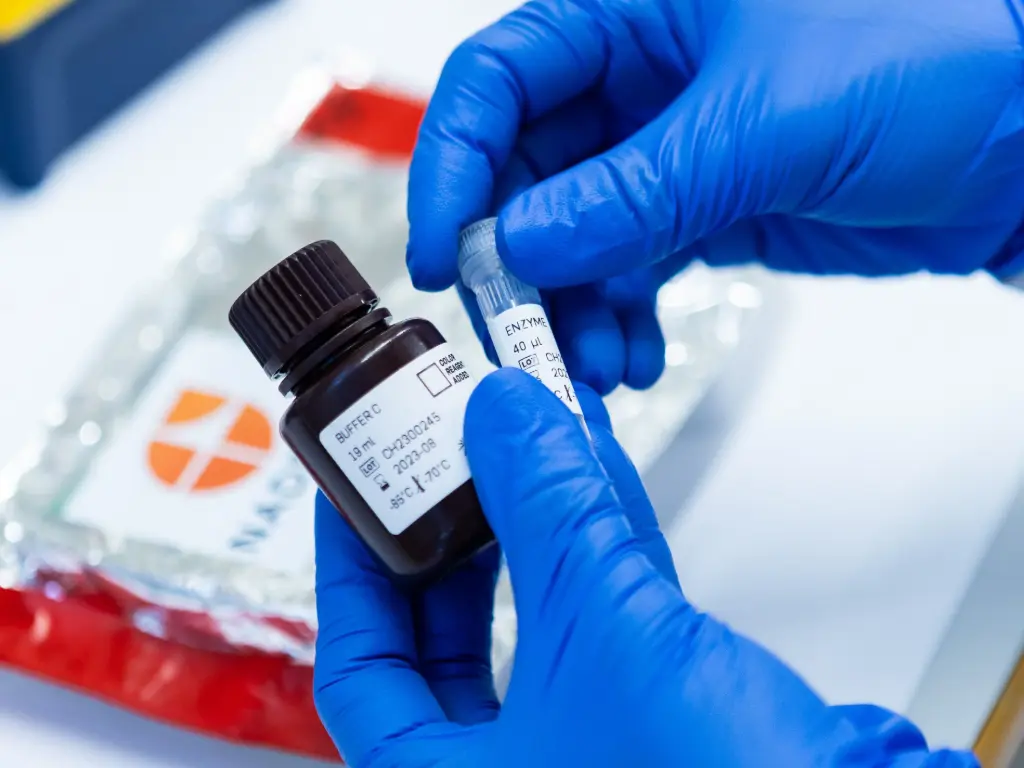
- ASSAY BUFFER C
- ASSAY COLOR REAGENT
- NAD+ STANDARD STOCK
- NADH STANDARD STOCK
- NAD ENZYME
Storage
If you are storing the kits for more than one month, place them in a freezer set to -80°C. If you plan to run the assay within four weeks, the kits may be stored at stable -20°C.
Precautions and Warnings
- For research use only by trained personnel.
- The STOP SOLUTION may cause skin, eye, and respiratory irritation. Avoid breathing in fumes.
- ASSAY COLOR REAGENT may cause skin irritation. Handle with care, use gloves.
- EXTRACTION BUFFER B can cause eye irritation. Handle with care, use goggles.
For more information, please refer to the Safety Data Sheet (SDS) for the tissue/cells kit.
For more details on sample preparation, see the Tissue and Cells preparation instructions. If you are using the NADMED lysis buffer, please follow the Protocol for cell collection with NADMED lysis buffer.
The documents are available here.